Portfolio  ·  Project Management Practice

Where engineering rigor meets program discipline.

Project Manager with eight years of multi-industry manufacturing leadership across automotive, aerospace, and electronics environments. I deliver phase-gate launches, govern engineering change, defend capital business cases, and convert engineering complexity into measurable business outcomes.

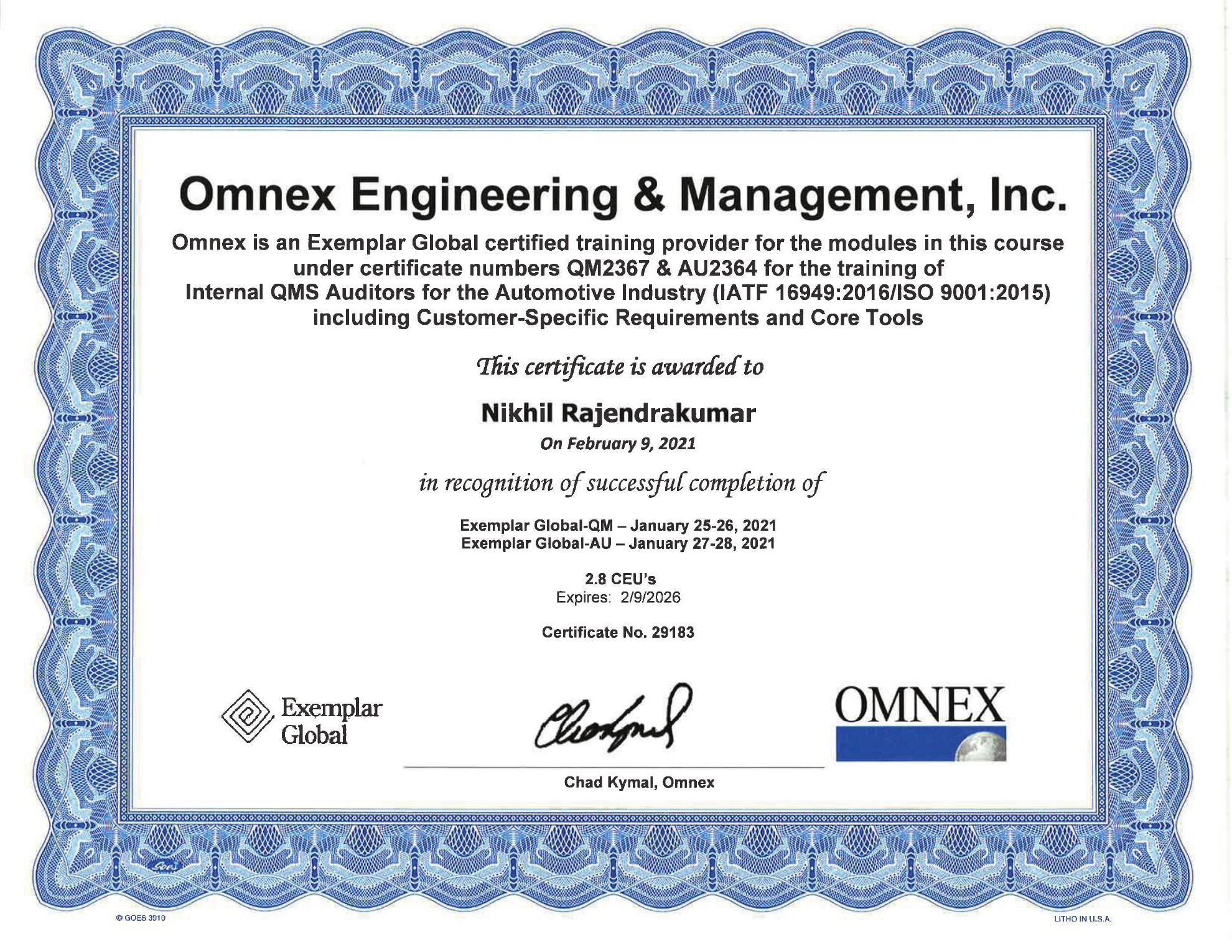
PMP® EIT — PEO ASQ CQE ASQ CSSGB
Portrait of Nikhil Rajendrakumar
01 / About

The practice.

Bio
Statement

I run programs the way a conductor runs an orchestra — every section in time, every soloist heard, the score followed where it serves, departed from where it doesn't.

My work spans multi-site, high-value product launches across automotive supplier environments serving major OEMs. I lead through phase-gate execution, APQP/PPAP governance, RAID-based risk control, and structured stakeholder communication — backed by ASQ-certified quality engineering rigor and hands-on operational excellence practice under Hoshin Kanri, Lean, and Six Sigma disciplines. The work is technical. The outcome is commercial. The discipline that bridges the two is project management.

02 / Practice

Four pillars.

How I work
— I.

Phase-Gate Launch Execution

APQP from Product Design Freeze through Start of Production. PPAP submission ownership, gate readiness reviews, stakeholder alignment, and disciplined milestone control.

— II.

Risk & Change Governance

Structured RAID logs, ECN/ECR coordination, contingency planning, executive escalation routines. Risk owned, tracked, retired — not just listed.

— III.

Capital & Commercial Defence

ROI, payback, cash-flow, and CAPEX business cases for tooling and equipment investments. Approval-grade analysis, supplier-led development, FAT/SAT through tool buy-off.

— IV.

Operational Excellence

Hoshin Kanri strategy deployment, Lean transformation, Six Sigma rigor. Applied VSM, SMED, 5S, Poka-Yoke, and structured A3 / 8D problem solving in manufacturing and launch environments.

Manufacturing Foundation

Engineering-grounded program leadership.

Structural Stamping & Material Flow

Automotive Tier-1 manufacturing environment

Front-end stamping and materials-flow improvement across a multi-press production environment, covering FLD / forming-simulation review, APQP stamping readiness, PFEP, packaging design, point-of-use flow, supermarket sizing, milk-runs, Kanban min-max logic, and tugger / forklift capacity modelling.

PFEPStampingKanbanPackaging

EV Thermal Systems & Process Validation

EV thermal systems manufacturing environment

Manufacturing engineering support for EV battery cooling systems, including APQP / PPAP coordination, PFMEA sessions, Control Plan / PFD / WI updates, equipment safety review, calibration, AviX work breakdowns, robotic-cell capacity improvement, and run-at-rate support for product transfer.

APQPPPAPPFMEARun@Rate

Aerospace Production Tools & Standard Work

Aerospace manufacturing environment

Operational excellence and manufacturing specialist work across aerospace cabin-interior production: manufacturing-method selection, production-tool improvement, serial-life change management, layout changes, operational-maturity actions, standard work, line pacing, prototype build support, and supplier / engineering troubleshooting.

OPEXStandard WorkToolsNPLM
03 / Selected Programs

Customer portfolio.

Sanitized — NDA
Customer names, platform codes, and capital values redacted under standing confidentiality obligations. Specifics available under NDA on request.
i
Automotive · EV Global OEM
Tier-1 automotive supplier environment
Phase: B-Release → SOP

EV Platform Launch — Welded BIW Brackets.

Technical Scope APQP B-Release phase execution; MIG / Projection-Weld assembly optimization; weld feasibility and tooling alignment for multi-component sub-assemblies.
  • Tooling and feasibility alignment with strategic supplier base
  • R&D ROI justification for SPOT welding and structural-adhesive CAPEX
  • Cross-functional gate-readiness governance through to PPAP submission
ii
Automotive · SUV North American OEM
Tier-1 automotive supplier environment
Phase: RFQ → MPA Audit

SUV Facelift Program — Stamped & E-Coated Component.

Technical Scope Multi-stage deep-draw forming, customer material specification compliance, special-process audit readiness, APQP workbook coordination.
  • RFQ management through customer sourcing portal and formal commercial workflow
  • Manufacturing process audit preparation for supplier onboarding
  • Design feasibility, change-notice handling, cost engineering, and tool-feasibility alignment with customer engineering
iii
Automotive · Light Truck North American OEM
Tier-1 automotive supplier environment
Phase: SREA / Change

Light Truck Platform — Structural Cross-Beams & Brackets.

Technical Scope Welded shield bracket assemblies; packaging change governance; shield-gas transition for weld process; thermal and vibration stability validation.
  • Formal change-approval coordination through customer engineering
  • TVM (target value management) coordination on cost-down stream
  • Shield gas transition managed without production disruption
iv
Automotive · HV / EV Tier-2 automotive supplier environment
End customer: global platform
Phase: Interim → Full PPAP

HV Structural Assembly — Welded Cross-Tube Seat Assembly.

Technical Scope Robotic welding with structural fillet and circular seam requirements, programmable-gauge dimensional KPC verification, weld-validation planning, and functional-test readiness per safe-launch requirements.
  • APQP / PPAP planning from interim PPAPs through SOP readiness
  • Dimensional and capability readiness — short-run studies, fixture correlation, and capability-target tracking
  • Safe-launch plan definition and sampling strategy alignment
v
Automotive · Seat Structures Tier-2 automotive supplier environment
Multi-site launch environment: North America / Europe
Phase: Feasibility → PPAP / Production Readiness

Multi-Site BIW Seat-Structure Program — Welded Cross-Tube & Back-Panel Assemblies.

Technical Scope MAG-welded and laser-welded seat-structure assemblies; stamped components, purchased sub-components, turntable concepts, fixture planning, and equipment-reuse evaluation across the wider manufacturing network.
  • Coordinated timing, feasibility, and supplier alignment across North American and European manufacturing teams, the Tier-1 customer, and weld/tooling suppliers
  • Owned milestone readiness for tooling, weld fixtures, raw material, prototype builds, PPAP documentation, and production-readiness preparation
  • Maintained management-level risk, action, investment, and sourcing-decision summaries covering tooling/equipment options, engineering changes, and technical-readiness topics
04 / Methodology

New product development.

Lifecycle Discipline

NPD ownership for me is not a sequence of meetings — it is a continuous discipline that begins with investment validation and CAPEX approval, integrates tool lifecycle and amortization planning, and runs in parallel with change management costing across every gate.

Each phase has named deliverables, named owners, and measurable readiness criteria. The framework — at right — is one I have applied across automotive supplier, aerospace cabin-interior, and EV powertrain programs over the past eight years.

01 Phase-Gate Driven Product Launch APQP framework execution · multi-disciplinary reviews 02 Engineering & Technical Reviews GD&T and tolerance-stack feasibility · manufacturability 03 Safe Launch Management Cp / Cpk · Gage R&R · MSA · defect tracking · 8D integration 04 Material Life & Packaging Integration Packaging design reviews · material BOM structuring 05 Cost & Margin Engineering Tool amortization · process-margin breakdown · claim closure → SOP Start of Production
Fig. 01 — Five-stage NPD lifecycle, phase-gate governed
05 / APQP

Advanced product quality planning.

Program Management Role in PPAP Readiness

Role mapping reflects launch program management accountability: driving timing, cross-functional readiness, escalation, and gate discipline while technical ownership remains with Engineering, Quality, Manufacturing, Metrology, Supplier Quality, and Operations as applicable.

Phase Deliverable PM Role
PlanningPPAP PlanLead
Product Design & DevelopmentAuthorized Engineering Change DocumentsTrack
Bill of MaterialsCoordinate
Design FMEASupport
Process Design & DevelopmentProcess Flow DiagramReview
Process FMEAReview
Control PlanReview
Customer Owned ToolsLead
Special Processes — CoatingTrack
Product ValidationDimensional TestTrack
PPAP SamplesLead
PPAP Master SampleTrack
Production Process ValidationMeasurement System AnalysisTrack
Process Capability StudiesTrack
Part Submission WarrantSupport
Capacity AnalysisLead
Lead Drive timing, readiness, closure
Review Gate-level review
Track Monitor and escalate
Coordinate Cross-functional alignment
Support Support technical owner
06 / Project Controls

Earned-value discipline.

Schedule · Cost · Risk
Illustrative anonymized program — paused mid-cycle then restarted under controlled spend. Original program currency and customer redacted; control approach identical.

EVM. Earned Value flatlined during a Q1–Q3 hold; the post-hold restart re-accelerated EV against a controlled actual-cost trajectory, with Actual Cost approaching ~690k by the eighth month.

SPI / CPI. Schedule Performance Index dipped during the hold and recovered post-restart; Cost Performance Index stabilized and improved — better cost efficiency relative to earned progress.

RAID. The hold drove RAID backlog aging; post-restart closure throughput accelerated and open items burned down month-over-month — visible in the RAID aging proxy at right.

EVM S-Curve (k USD) 0 200 400 600 800 N D J F M A M J J A S O N D PROGRAM HOLD EV — Earned Value PV — Planned Value AC — Actual Cost
Fig. 02 — EVM S-curve with mid-program hold and recovery
SPI / CPI Trend 0 0.25 0.5 0.85 1.0 SPI 0.986 CPI 0.954
Fig. 03 — SPI / CPI recovery through program restart
RAID Aging — Stacked (days) 0 10 20 30 40 HOLD 0–30 31–60 61–90 >90
Fig. 04 — RAID aging proxy, Nov-24 to Dec-25
07 / Operational Excellence

OpEx portfolio.

Manufacturing systems & continuous improvement
Cost Reduction · Portfolio
6.0M+
Anonymized aggregate savings across OpEx portfolio, 2015–2025
Projects Led / Supported
100+
Cross-functional improvement projects across quality, ops, logistics, IE
Investment Cases Defended
USD 6M+
Tooling and equipment investment business cases
Production Systems Span
Multiline
Daily-management support across production systems
OpEx Portfolio — Cost Savings YoY (in k EUR) 0 500 1000 1500 2000 967 2015 1,267 2016 2,096 2017 925 2018 50 2022 160 2023 387 2024 285 2025
Fig. 05 — Portfolio cost savings YoY · OpEx programs led or supported, 2015 through 2025

Project breakdown by function.

31% 21% 20% 17% 10%
Operations · 31%
Industrial Eng · 21%
Logistics · 20%
Quality · 17%
Purchasing · 10%
Admin · 1%

Selected major projects.

2025
Automated validation method improvement
Reduced manual effort and recurring validation cost
2025
Industrialization cost-control program
Launch-spend governance and cost avoidance
2025
Process validation and safe-launch readiness
Reduced containment and validation risk
2024
Material-substitution cost improvement
Material conversion and cost reduction
2024
In-die detection improvement
Simulation-led sensor placement and quality prevention
08 / Lean Journey

Operational excellence roadmap.

Four-year deployment arc
Q1 — Y1
Idea Management
Q2 — Y1
Lean Training
Q2 — Y2
5S Implementation
Q3 — Y2
VSM & KPI Leadership
Q4 — Y2
Systematic Lean Tools
Y3 — Y4
Management Enforcement & Standardization

Idea Management. Plant-wide program integrating motivation and appreciation into the corporate culture — transparent communication, recognition of contributors, success-sharing routines.

Over a four-year deployment cycle, the program delivered measurable improvements in employee participation, implementation rate, and direct cost savings — sustained through structured monitoring, management buy-in routines, and dedicated training tracks.

5S as a culture, not a checklist. The objective was never zone audits — it was developing a culture of 5S in thinking: quality at the source, process respect, and abnormality visibility. Bronze certification across all lines, BIC-level sustenance across three years.

Idea Management Outcomes · 2014 – 2018 EMPLOYEE PARTICIPATION 99% peak · 2017 Floor 92% → Peak 99% IMPLEMENTED IDEAS / HEAD 5.2 ideas/employee · 2018 Up from 4.2 baseline COST-SAVINGS MOMENTUM Multi-year Sustained 2016–2018 GLOBAL RANKING Top 16 Across global plant network · 2018
Fig. 06 — Multi-year continuous improvement program
09 / Problem Solving

Structured resolution.

A3 · 8D · DMAIC
A3 TITLE — Problem Description 1 — Describe Problem Gemba / Go & See Key Questions · Is / Is-Not SIPOC · Process Map Pareto · Flow Chart Histogram · SPC Diagram PLAN 3 — Solve / Counter Impact Analysis Brainstorming Benefit – Effort Diagram Poka-Yoke · PDCA · VSM Countermeasures defined DO 2 — Root Cause Analysis Fish-Bone / Ishikawa Affinity · Fault Tree 5-Why · Current Reality Tree FMEA · DOE Validated cause chain 4 — Validate & Standardize SPC Diagram · Histogram Process Mapping Standard Work Lessons Learned Distribution / Scatter CHECK ACT
Fig. 07 — A3 problem solving · PDCA-mapped four-quadrant template

Objectives. Problems triggered by the system. Escalated to the right hierarchy. Fixed in a structured way.

I trained shopfloor leaders, support functions, and QC personnel on the A3 methodology — coaching teams on approach selection, reviewing problem-solving efficiency through Leader Standard Work reports, and fostering rigor over reflex.

The discipline is the same whether the problem is a customer complaint, an internal nonconformance, a supplier defect, or a launch-readiness gap: describe → root-cause → solve → standardize. The tools change. The structure does not.

Jishuken workshops apply the same logic to capacity and capability — Gemba observation, job-element understanding, Yamazumi balancing, zone capacity and buffer management, trial kaizen, standard update. Measurable in KPI shift, sustainable in standard work change.

10 / Strategy

Hoshin Kanri deployment.

Vision → Implementation
01 Vision Ideal state 02 Strategic Topics Tangible vision 03 Positioning Current state 04 Goals Future state 05 Planning Tactical implementation 06 Implementation Put to practice
Fig. 08 — Six-stage Hoshin Kanri strategy deployment framework

I use Hoshin Kanri as a practical strategy-deployment method: turning broad business priorities into focused initiatives, measurable targets, assigned ownership, and a regular review rhythm.

Across manufacturing engineering, launch management, and operational excellence work, the value is the same — align teams around what matters, translate strategy into executable plans, and keep progress visible through clear KPIs, owners, risks, and countermeasures.

Strategic focus areas:

— Customer value and launch readiness
— Operational performance across Safety, Quality, Delivery, Cost, and People
— Process stability, standard work, and continuous improvement
— Cross-functional accountability through clear ownership and review cadence
— Capacity, resources, and execution risk management
— Strategic initiatives converted into measurable project outcomes
— Leadership engagement, team alignment, and sustainable change adoption

Credentials
Academic foundation.
Graduate
Master of Engineering — Industrial Engineering.
Concordia University · Montréal, Canada
Jan 2019 – Apr 2021
Graduate
Master of Technology — Industrial Engineering & Management.
GITAM University · India
Jul 2013 – Jul 2015
Undergraduate
Bachelor of Engineering — Mechanical Engineering.
University of Kerala · India
Sep 2007 – Apr 2012
11 / Recommendations

In their words.

Colleagues · Leaders · Reports

I had the pleasure of working with Nikhil on several projects, and he consistently demonstrated a level of organization and attention to detail that kept everything running smoothly, even under pressure. As a project manager, Nikhil has a strong ability to balance structure with flexibility, adapting quickly when priorities shift or unexpected challenges arise.

What really stands out is his communication style. Nikhil is equally effective speaking with operators on the ground, aligning with management on strategic goals, and engaging directly with customers. He has a natural ability to translate needs across these groups, ensuring everyone stays informed, aligned, and confident in the direction of the project.

Beyond his technical strengths, Nikhil brings a personable and steady presence to the team. He approaches challenges with a calm, solutions-focused mindset that helps keep morale high and projects moving forward. I would gladly work with Nikhil again and highly recommend him for any role that requires strong leadership, adaptability, and clear communication.

Ian Bailey, P.Eng
Manufacturing Engineer
Worked on the same team
Apr 2026

I had the pleasure of working with Nikhil in his capacity as a Project Manager, where he was responsible for overseeing automotive product launches for high-volume production programs. In this role, he consistently demonstrated strong organizational skills, a keen attention to detail, and effective communication across cross-functional teams.

Nikhil has a clear ability to manage complex projects with discipline and structure, ensuring that key milestones are met and that stakeholders remain well-informed throughout the process. His involvement in coordinating and executing automotive launches contributed to the successful transition of programs into production, often under demanding timelines.

He is a dependable and professional individual who brings clarity and consistency to his work, and I would confidently recommend him for roles requiring strong project management capability in a fast-paced environment.

Brad King
Project Controls Specialist, BWXT Technologies, Inc.
Senior to Nikhil (non-direct manager)
Apr 2026

I have known Nikhil since 2015. I found him to be highly motivated, creative, very enthusiastic and self-driven. He has been instrumental in the implementation of lean initiatives and programs in Continental Bangalore Plant. For example, he has taken the leadership role for the plant wide implementation of 5S Best-in-Class standard.

Eliseo Paz
Passionate in helping organizations transform themselves towards operational excellence
Senior to Nikhil (non-direct manager)
Dec 2018

I see Nikhil as hardworking, collaborative and quite focused on his job on Lean Methodologies and business excellence. He is a talent powerhouse and I am confident he will grow to great heights in his career ahead.

I wish him all the very best for his PG studies and future endeavors.

Sebastian Ananthaswamy
General Manager Operations
Managed Nikhil directly
Oct 2018

Let's talk.

Open to senior Project Management and Program Management roles across manufacturing, aerospace, regulated industries, and industrial-equipment sectors. Based in Kitchener, Ontario; commute radius 100 km; hybrid welcome; relocation considered for the right role.